Pacific Atrocities Education
  • Home
    • Host a Fundraiser for Pacific Atrocities Education
    • About >
      • FAQ's - Frequently Asked Questions
    • Support Us >
      • Projects you can support! >
        • Distributing Books
        • Presenting at 112th Annual Meeting of Pacific Coast Branch
        • Summer Research Relocation Fund
    • Contact
  • Stories
    • James Bradley on Pacific Front Untold
    • Videos >
      • Black Hearts (2021)
    • Blog
  • Internship
    • Summer 2026 Internship
    • Fall 2025 Internship
    • Summer 2025 Internship
    • Spring 2025 Internship
    • Summer 2024 Internship
    • Summer 2023 Internship
    • Fall 2022 Internship
    • Summer 2022 Internship
    • Summer 2021 Internship
    • Fall 2020- Spring 2021 Internship
    • Summer 2020 Internship
    • Fall 2019 Internship
    • Summer 2019 Internship >
      • Public History Night
    • School Year 2018-2019 Internship
    • Summer 2018 Internship >
      • 2018 Summer Showcase + Fundraiser
    • Fall 2017 Internship
    • Summer 2017 Internship >
      • 2017 Summer Showcase & Fundraiser
  • Books
  • Archives
  • Resource Page
    • Supplementary Research Guides >
      • Unit 731 - Guide >
        • Background of Biochemical Warfare Development
        • Imperial Japan's Chemical Warfare Development Program
        • Map of Unit 731
        • Personnel of Unit 731
        • Duties of Unit 731
        • Human Experimentation
        • [GRAPHIC] Germ Warfare Attacks
        • Cover Ups After the War
        • [OLD] Cover Ups After the War
      • Philippines' Resistance - Guide >
        • Philippines World War II Timeline
        • The Japanese Invasion & Conquest of the Philippines
        • Bataan Death March
        • Formation of Underground Philippines Resistance
        • Supplies of the Guerrilla Fighters
        • The Hukbalahap
        • Hunter's ROTC
        • Marking's Guerrillas
        • United States Army Forces in the Philippines of Northern Luzon (USAFIP-NL)
        • The Aetas
        • Chinese and Filipino-Chinese Nationalist Guerrilla Units
        • The Female Faces of the Philippine Guerrillas
      • Rising Sun Flag - Guide >
        • History of the Rising Sun Flag
        • Atrocities Committed Under the Flag
        • Rising Sun Flag in Pop Culture
      • Pinay Guerrilleras - Guide >
        • Japanese Occupation of the Philippine Islands: Pinays Answering the Call to Arms
        • The Fierce Heneralas and Kumanders of the Hukbalahap Guerrillas
        • Amazons of the Pacific Theater
        • Filipina American Veterans: Recovering the Extraordinary Feats of the Ordinary Pinays
        • The Legacy of the Asian Women Soldier
      • Fall of Singapore - Guide >
        • Singapore World War II Timeline
        • History of World War II in the Pacific
        • History of Singapore
        • Japan's Conquest in Asia
        • Japan's Invasion of the Malay Peninsula
        • Sook Ching Massacre
        • Double Tenth Incident
        • Social Changes and Challenges in Singapore
        • Voices from Syonan
        • Return to British Rule
      • Three Years and Eight Months - Guide >
        • Hong Kong before WW2
        • Buildup to World War 2
        • The Battle of Hong Kong
        • Life during 3 Years and 8 Months
        • East River Column Guerrilla Fighters
        • Prisoners of War Camps
        • End of Japanese Occupation
        • War Crimes Trials
      • Siamese Sovereignty - Guide >
        • The Land of Smiles
        • The Thai-Japanese Relationship
        • Phibun’s Domestic and International Policies
        • The Free Thai Resistance Movement
        • Post WW2 Aftermath of Thailand
      • The Khabarovsk War Crimes Trial - Guide >
        • Defendants of Khabarovsk War Crime
        • The Japanese Empire and USSR in WW2
        • The Employment of the Bacteriological Weapon in the War
        • Planning of Japan invasion to USSR
      • Unit 731 Cover-up : The Operation Paperclip of the East - Guide >
        • Establishing Manchukuo
        • The Development of Unit 731
        • Plan Kantokuen and Bacteriological Warfare
        • The Downfall of the Japanese WW2 Era
        • Three Stages of Interrogations
        • Lasting Impacts
      • Marutas of Unit 731 - Guide >
        • How did Ishii Shiro start unit 731?
        • A Beta Testing Site
        • Establishing Pingfan
        • Experiences at the Human Experimentation Complex
        • Vivisection at the Unit 731
        • Anta Testing Grounds
        • Overall Advance from the Laboratory Creations
        • The End of the War
      • Prince Konoe Memoir - Guide >
        • Who is Prince Konoe?
        • Preparation to Tripartite Pact
        • Emperor Hirohito and Prince Konoe
        • The End of Prince Konoe
      • Competing Empires in Burma - Guide >
        • What was the China-Burma-India Theater?
        • When did the China-Burma-India Theater Happen?
        • Who Fought in the China-Burma-India Theater?
        • The Second Sino Japanese War
        • Japan in the South
        • Operation U-Go
      • Battle of Shanghai - Guide >
        • The Battle of Shanghai. Background
        • Shanghai Before War
        • The First Battle of Shanghai 1932
        • Battle of Shanghai 1937
        • Aftermath of Battle for Shanghai
      • Ishi Shiro - Guide >
        • History of Biological Weapons and The Young Ishii Shiro
        • Establishment in Manchuria
        • Pingfang District - Harbin
        • Failures and Corruption
        • Post War
      • Taiwan The Israel of the East - Guide >
        • Background of Formosa
        • Industrialization of Japan
        • China During WWII
        • Taiwan under Kuomintang
        • New Taiwanese National Identity
      • Seeking Justice for Biological Warfare Victims of Unit 731 - Guide >
        • Introduction of Wang Xuan
        • Colonel Memorandum
        • The Beginning of Biological Warfare
        • The Bacteriological Warfare on China
        • Victims in Zhejiang’s Testimonies
        • After the War
      • Rice and Revolution - Guide >
        • The French Colonial Period
        • Anti-Colonial Resistance
        • The Rise of the Communist Movement
        • Imperial Japan’s Entry into Indochina
        • The Portents of Famine
        • The Famine (1944-45)
        • Legacy of the 1944-45 Vietnam Famine
      • Clash of Empires - Guide >
        • Japan’s Imperialist Origins
        • Japan’s Competition against the West: Nanshin-ron and Hokushin-ron
        • Japanese Imperialism Through the Lens of French Indochina
        • The U.S.-Japan Relations and the Pearl Harbor Attack
      • Hunger for Power and Self-SufficiencyI - Guide >
        • The Influence of War Rations on Post-War Culinary Transformations
        • How World War II Complicated Food Scarcity and Invention
        • American Military Innovations
        • Government-Sponsored Food Inventions in Europe during World War II
        • Feeding the Army: The Adaptation of Japanese Military Cuisine and Its Impact on the Philippines
        • Mixed Dishes: Culinary Innovations Driven by Necessity and Food Scarcity
      • Denial A Quick Look of History of Comfort Women and Present Days’ Complication - Guide >
        • The Comfort Women System and the Fight for Recognition
        • The Role of Activism and International Pressure
        • The Controversy over Japanese History Textbooks
        • The Sonyŏsang Statue and the Symbolism of Public Memorials
        • Activism and Support from Japanese Citizens
        • The Future of Comfort Women Memorials and Education
      • Echoes of Empire: The Power of Japanese Propaganda - Guide >
        • Brief Overview of Imperial Japan
        • Defining Propaganda
        • Propaganda Encouraging Action​
        • The Rise of Nationalism
        • The Formation of Japanese State Propaganda
        • Youth and Education
      • Shadows of the Rising Sun: The Black Dragon Society and the Dawn of Pan-Asianism - Guide >
        • Origins of the Black Dragon Society
        • The Influence of Pan-Asianism
        • Relationship with Sun Yat-sen
        • The Role in Southeast Asia
        • The Spread of Ideology and Espionage
        • Disbandment and Legacy
      • Chongqing Bombing: The Forgotten Blitz of Asia and Its Lasting Impact - Guide >
        • Introduction and Historical Background
        • The Class Divide During the Bombings
        • Resilience and Unity of Chongqing
        • Key Incidents - Great Tunnel Massacre
        • The Aftermath of the Bombings
        • Legacy and Commemoration
      • Shanghai's International Zone: A Nexus of War, Intelligence, and Survival - Guide >
        • Historical Background
        • The International Zone
        • Battles in Shanghai
        • Civilian Intelligence Efforts
        • Wartime Brutality
        • Aftermath & Legacy
      • Operation Ichigo A struggle of strategies and alliances in the China Theater​ - GUIDE >
        • Strategic Background of Operation Ichigo
        • Prelude to Ichigo: Internal Chinese Challenges
        • Planning and Execution of Operation Ichigo
        • Logistical Struggles & Air Power
        • Sino-American Command Crisis
        • Consequences & Legacy of Operation Ichigo
      • The Rise of the Kwantung Army: ​Japan’s Empire in Manchuria to 1932 - Guide >
        • European Modernity Arrives in East Asia
        • The Meiji Restoration and Military Modernization
        • Secret Societies and Intelligence Networks
        • Japan’s “Two Splendid Little Wars”​
        • From Treaty to Territory: Kwantung Leased Territory and the SMR
        • Empire by Soybean: Economy, Ports, and Settlement
        • China in Turmoil: Warlords, Nationalists, and a Fragmented Republic
        • Positive Policy and Gekokujō
        • Countdown to 1931
        • Mukden and the Conquest of Manchuria
        • Manchukuo and the Politics of Puppet States
        • Legacies and Lessons
      • Unveiled Horrors: ​Uncovering Japan’s Wartime Human Experimentation - Guide >
        • Human Experimentation in the Tokyo Region POW Camps
        • Unit 731 Background and Shiro Ishii
        • Shinagawa POW Hospital and Dr. Hisakichi Tokuda
        • Kyushu Imperial University Vivisections
        • Gendered & Hierarchical Dynamics of Human Experimentation
        • The Collapse of Japanese Medical Ethics in WWII
    • Lesson Plans >
      • Reparations
      • Ethics in Science
      • Writing the Narrative of a Pinay Fighter
      • Privilege Journal
      • Environmental Injustices
      • Female Guerrillas
      • Hunter's ROTC
      • Scientific Advancements
      • Seeking Justice: A Humanities Lesson Plan
      • The Hukbalahap
      • Trading Immunity
      • Bataan Death March
      • Biochemical Warfare Development
  • Membership
Contribute

The Dixie Mission: A Forgotten Chapter in U.S. -China Relations

4/26/2024

2 Comments

 
by Jenny Chan
Picture
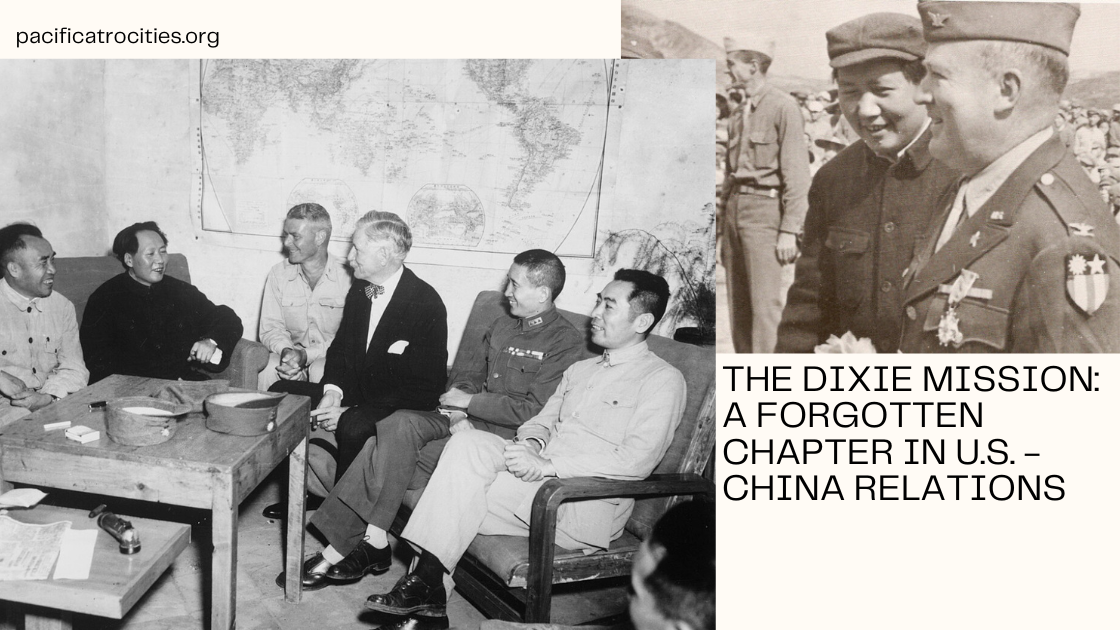
The Dixie Mission, officially known as the United States Army Observation Group, represents a pivotal yet often overlooked chapter in the history of Sino-American relations during World War II. This mission was the first instance of American military personnel being officially stationed in a communist-held area anywhere in the world. Operating between 1944 and 1947, the Dixie Mission aimed to establish a U.S. presence within the Yan'an region, the stronghold of the Chinese Communist Party (CCP) led by Mao Zedong. The mission's implications extend far beyond its immediate military and political objectives, offering a unique lens through which to view the complexities of wartime diplomacy and the groundwork of future international alignments.
The Dixie Mission provides a critical historical lens for examining the complexities and potentials of international relations, illustrating how diplomatic and military engagements can significantly influence global politics.
Context and Origins
The Dixie Mission originated against the backdrop of the Second Sino-Japanese War, a brutal conflict that merged into the larger theatrics of World War II. By the early 1940s, China had been embroiled in a protracted war against Japanese aggression. The United States, seeking to support China while also countering Japanese expansion, found itself in a strategic alliance with both the Nationalist government under Chiang Kai-shek and, by extension, through the Dixie Mission, with the Chinese Communists.
The mission aimed to observe and report on the Communist forces, provide them with advice and limited aid, and assess their potential as an ally against the Japanese. It also sought to investigate the possibility of mediating a reconciliation between the Communists and Nationalists, whose internal strife threatened the unified front against Japan. (Bergin, 2019)
Activities and Interactions
Led by Colonel David D. Barrett, the Dixie Mission included military, diplomatic, and intelligence personnel who interacted closely with the top leadership of the CCP, including Mao Zedong and Zhou Enlai. These interactions provided the Americans with unprecedented insights into the ideological convictions and operational capacities of the Chinese Communists.
Members of the Dixie Mission engaged in various activities, from medical and logistical support to training sessions on guerrilla warfare tactics. They were also instrumental in facilitating some of the earliest exchanges between the CCP leaders and the Western world, thus helping to shape perceptions and policies long before the onset of the Cold War (Barrett, 1947).
Impact and Legacy
The Dixie Mission's legacy is complex and layered. Initially, the mission facilitated a deeper understanding and some level of mutual respect between the American personnel and Chinese Communists. Reports sent back to Washington by the mission members painted a picture of the CCP that contrasted sharply with the prevailing Western perception of communism. These reports highlighted the discipline, motivation, and popular support enjoyed by the CCP, challenging the narrative espoused by the Nationalists ("U.S. Relations with the Chinese Communists: 1944–1947." Diplomatic History, 1981).
Despite these insights, the broader U.S. policy did not shift significantly in favor of the Communists during the immediate post-war years. The onset of the Cold War and the eventual triumph of the CCP in the Chinese Civil War in 1949 led to a reassessment of the Dixie Mission's insights and conclusions.
Conclusion
The Dixie Mission remains a fascinating study of wartime diplomacy, ideological encounters, and the complexities of international politics. It serves as a reminder of the nuanced histories that shape today's geopolitical landscapes and underscores the importance of understanding and engaging with diverse political ideologies.
References
  1. Bergin, Bob "The Dixie Mission 1944: The First US Intelligence Encounter with the Chinese Communists." Studies in Intelligence Vol. 63, No. 3, 2019 https://www.cia.gov/resources/csi/static/The-Dixie-Mission-1944.pdf
  2. Barrett, David D. "Dixie Mission: The United States Army Observer Group in Yenan, 1944." China Quarterly Review, 1947.
  3. "U.S. Relations with the Chinese Communists: 1944–1947." Diplomatic History, 1981.
2 Comments
Telkom University link
5/11/2024 10:31:59 pm

Nice for information
<a href="http://www.nevyansk.org.ru/go?https://bte-jkt.telkomuniversity.ac.id/spektrum-elektromagnetik/">LINK</a>
<a href="http://www.listenyuan.com/home/link.php?url=https://see.telkomuniversity.ac.id/5-materi-dasar-teknik-elektro-calon-mahasiswa-elektro-wajib-tahu/">LINK</a>
<a href="https://www.signlink.co.uk/ACL.aspx?t=3&i=494&l=https://telkomuniversity.ac.id/en/pengenalan-almamater-fakultas-teknik-elektro-telkom-university/">LINK</a>

Reply
Telkom University link
5/19/2024 07:08:51 pm

How did "The Dixie Mission" impact the perception of China within the United States during World War II?

Reply


Leave a Reply.

Pacific Atrocities Education
1639 Polk Street #1070
San Francisco, CA 94109
​415-988-9889
Copyright © 2021 Pacific Atrocities Education.
​We are a registered 501 (c)(3) charity. All donations are tax deductible.​
Donate Now
  • Home
    • Host a Fundraiser for Pacific Atrocities Education
    • About >
      • FAQ's - Frequently Asked Questions
    • Support Us >
      • Projects you can support! >
        • Distributing Books
        • Presenting at 112th Annual Meeting of Pacific Coast Branch
        • Summer Research Relocation Fund
    • Contact
  • Stories
    • James Bradley on Pacific Front Untold
    • Videos >
      • Black Hearts (2021)
    • Blog
  • Internship
    • Summer 2026 Internship
    • Fall 2025 Internship
    • Summer 2025 Internship
    • Spring 2025 Internship
    • Summer 2024 Internship
    • Summer 2023 Internship
    • Fall 2022 Internship
    • Summer 2022 Internship
    • Summer 2021 Internship
    • Fall 2020- Spring 2021 Internship
    • Summer 2020 Internship
    • Fall 2019 Internship
    • Summer 2019 Internship >
      • Public History Night
    • School Year 2018-2019 Internship
    • Summer 2018 Internship >
      • 2018 Summer Showcase + Fundraiser
    • Fall 2017 Internship
    • Summer 2017 Internship >
      • 2017 Summer Showcase & Fundraiser
  • Books
  • Archives
  • Resource Page
    • Supplementary Research Guides >
      • Unit 731 - Guide >
        • Background of Biochemical Warfare Development
        • Imperial Japan's Chemical Warfare Development Program
        • Map of Unit 731
        • Personnel of Unit 731
        • Duties of Unit 731
        • Human Experimentation
        • [GRAPHIC] Germ Warfare Attacks
        • Cover Ups After the War
        • [OLD] Cover Ups After the War
      • Philippines' Resistance - Guide >
        • Philippines World War II Timeline
        • The Japanese Invasion & Conquest of the Philippines
        • Bataan Death March
        • Formation of Underground Philippines Resistance
        • Supplies of the Guerrilla Fighters
        • The Hukbalahap
        • Hunter's ROTC
        • Marking's Guerrillas
        • United States Army Forces in the Philippines of Northern Luzon (USAFIP-NL)
        • The Aetas
        • Chinese and Filipino-Chinese Nationalist Guerrilla Units
        • The Female Faces of the Philippine Guerrillas
      • Rising Sun Flag - Guide >
        • History of the Rising Sun Flag
        • Atrocities Committed Under the Flag
        • Rising Sun Flag in Pop Culture
      • Pinay Guerrilleras - Guide >
        • Japanese Occupation of the Philippine Islands: Pinays Answering the Call to Arms
        • The Fierce Heneralas and Kumanders of the Hukbalahap Guerrillas
        • Amazons of the Pacific Theater
        • Filipina American Veterans: Recovering the Extraordinary Feats of the Ordinary Pinays
        • The Legacy of the Asian Women Soldier
      • Fall of Singapore - Guide >
        • Singapore World War II Timeline
        • History of World War II in the Pacific
        • History of Singapore
        • Japan's Conquest in Asia
        • Japan's Invasion of the Malay Peninsula
        • Sook Ching Massacre
        • Double Tenth Incident
        • Social Changes and Challenges in Singapore
        • Voices from Syonan
        • Return to British Rule
      • Three Years and Eight Months - Guide >
        • Hong Kong before WW2
        • Buildup to World War 2
        • The Battle of Hong Kong
        • Life during 3 Years and 8 Months
        • East River Column Guerrilla Fighters
        • Prisoners of War Camps
        • End of Japanese Occupation
        • War Crimes Trials
      • Siamese Sovereignty - Guide >
        • The Land of Smiles
        • The Thai-Japanese Relationship
        • Phibun’s Domestic and International Policies
        • The Free Thai Resistance Movement
        • Post WW2 Aftermath of Thailand
      • The Khabarovsk War Crimes Trial - Guide >
        • Defendants of Khabarovsk War Crime
        • The Japanese Empire and USSR in WW2
        • The Employment of the Bacteriological Weapon in the War
        • Planning of Japan invasion to USSR
      • Unit 731 Cover-up : The Operation Paperclip of the East - Guide >
        • Establishing Manchukuo
        • The Development of Unit 731
        • Plan Kantokuen and Bacteriological Warfare
        • The Downfall of the Japanese WW2 Era
        • Three Stages of Interrogations
        • Lasting Impacts
      • Marutas of Unit 731 - Guide >
        • How did Ishii Shiro start unit 731?
        • A Beta Testing Site
        • Establishing Pingfan
        • Experiences at the Human Experimentation Complex
        • Vivisection at the Unit 731
        • Anta Testing Grounds
        • Overall Advance from the Laboratory Creations
        • The End of the War
      • Prince Konoe Memoir - Guide >
        • Who is Prince Konoe?
        • Preparation to Tripartite Pact
        • Emperor Hirohito and Prince Konoe
        • The End of Prince Konoe
      • Competing Empires in Burma - Guide >
        • What was the China-Burma-India Theater?
        • When did the China-Burma-India Theater Happen?
        • Who Fought in the China-Burma-India Theater?
        • The Second Sino Japanese War
        • Japan in the South
        • Operation U-Go
      • Battle of Shanghai - Guide >
        • The Battle of Shanghai. Background
        • Shanghai Before War
        • The First Battle of Shanghai 1932
        • Battle of Shanghai 1937
        • Aftermath of Battle for Shanghai
      • Ishi Shiro - Guide >
        • History of Biological Weapons and The Young Ishii Shiro
        • Establishment in Manchuria
        • Pingfang District - Harbin
        • Failures and Corruption
        • Post War
      • Taiwan The Israel of the East - Guide >
        • Background of Formosa
        • Industrialization of Japan
        • China During WWII
        • Taiwan under Kuomintang
        • New Taiwanese National Identity
      • Seeking Justice for Biological Warfare Victims of Unit 731 - Guide >
        • Introduction of Wang Xuan
        • Colonel Memorandum
        • The Beginning of Biological Warfare
        • The Bacteriological Warfare on China
        • Victims in Zhejiang’s Testimonies
        • After the War
      • Rice and Revolution - Guide >
        • The French Colonial Period
        • Anti-Colonial Resistance
        • The Rise of the Communist Movement
        • Imperial Japan’s Entry into Indochina
        • The Portents of Famine
        • The Famine (1944-45)
        • Legacy of the 1944-45 Vietnam Famine
      • Clash of Empires - Guide >
        • Japan’s Imperialist Origins
        • Japan’s Competition against the West: Nanshin-ron and Hokushin-ron
        • Japanese Imperialism Through the Lens of French Indochina
        • The U.S.-Japan Relations and the Pearl Harbor Attack
      • Hunger for Power and Self-SufficiencyI - Guide >
        • The Influence of War Rations on Post-War Culinary Transformations
        • How World War II Complicated Food Scarcity and Invention
        • American Military Innovations
        • Government-Sponsored Food Inventions in Europe during World War II
        • Feeding the Army: The Adaptation of Japanese Military Cuisine and Its Impact on the Philippines
        • Mixed Dishes: Culinary Innovations Driven by Necessity and Food Scarcity
      • Denial A Quick Look of History of Comfort Women and Present Days’ Complication - Guide >
        • The Comfort Women System and the Fight for Recognition
        • The Role of Activism and International Pressure
        • The Controversy over Japanese History Textbooks
        • The Sonyŏsang Statue and the Symbolism of Public Memorials
        • Activism and Support from Japanese Citizens
        • The Future of Comfort Women Memorials and Education
      • Echoes of Empire: The Power of Japanese Propaganda - Guide >
        • Brief Overview of Imperial Japan
        • Defining Propaganda
        • Propaganda Encouraging Action​
        • The Rise of Nationalism
        • The Formation of Japanese State Propaganda
        • Youth and Education
      • Shadows of the Rising Sun: The Black Dragon Society and the Dawn of Pan-Asianism - Guide >
        • Origins of the Black Dragon Society
        • The Influence of Pan-Asianism
        • Relationship with Sun Yat-sen
        • The Role in Southeast Asia
        • The Spread of Ideology and Espionage
        • Disbandment and Legacy
      • Chongqing Bombing: The Forgotten Blitz of Asia and Its Lasting Impact - Guide >
        • Introduction and Historical Background
        • The Class Divide During the Bombings
        • Resilience and Unity of Chongqing
        • Key Incidents - Great Tunnel Massacre
        • The Aftermath of the Bombings
        • Legacy and Commemoration
      • Shanghai's International Zone: A Nexus of War, Intelligence, and Survival - Guide >
        • Historical Background
        • The International Zone
        • Battles in Shanghai
        • Civilian Intelligence Efforts
        • Wartime Brutality
        • Aftermath & Legacy
      • Operation Ichigo A struggle of strategies and alliances in the China Theater​ - GUIDE >
        • Strategic Background of Operation Ichigo
        • Prelude to Ichigo: Internal Chinese Challenges
        • Planning and Execution of Operation Ichigo
        • Logistical Struggles & Air Power
        • Sino-American Command Crisis
        • Consequences & Legacy of Operation Ichigo
      • The Rise of the Kwantung Army: ​Japan’s Empire in Manchuria to 1932 - Guide >
        • European Modernity Arrives in East Asia
        • The Meiji Restoration and Military Modernization
        • Secret Societies and Intelligence Networks
        • Japan’s “Two Splendid Little Wars”​
        • From Treaty to Territory: Kwantung Leased Territory and the SMR
        • Empire by Soybean: Economy, Ports, and Settlement
        • China in Turmoil: Warlords, Nationalists, and a Fragmented Republic
        • Positive Policy and Gekokujō
        • Countdown to 1931
        • Mukden and the Conquest of Manchuria
        • Manchukuo and the Politics of Puppet States
        • Legacies and Lessons
      • Unveiled Horrors: ​Uncovering Japan’s Wartime Human Experimentation - Guide >
        • Human Experimentation in the Tokyo Region POW Camps
        • Unit 731 Background and Shiro Ishii
        • Shinagawa POW Hospital and Dr. Hisakichi Tokuda
        • Kyushu Imperial University Vivisections
        • Gendered & Hierarchical Dynamics of Human Experimentation
        • The Collapse of Japanese Medical Ethics in WWII
    • Lesson Plans >
      • Reparations
      • Ethics in Science
      • Writing the Narrative of a Pinay Fighter
      • Privilege Journal
      • Environmental Injustices
      • Female Guerrillas
      • Hunter's ROTC
      • Scientific Advancements
      • Seeking Justice: A Humanities Lesson Plan
      • The Hukbalahap
      • Trading Immunity
      • Bataan Death March
      • Biochemical Warfare Development
  • Membership
Contribute