Pacific Atrocities Education
  • Home
    • Host a Fundraiser for Pacific Atrocities Education
    • About >
      • FAQ's - Frequently Asked Questions
    • Support Us >
      • Projects you can support! >
        • Distributing Books
        • Presenting at 112th Annual Meeting of Pacific Coast Branch
        • Summer Research Relocation Fund
    • Contact
  • Stories
    • Videos >
      • Black Hearts (2021)
    • Blog
    • Podcast: Forgotten History
  • Internship
    • Summer 2026 Internship
    • Summer 2025 Internship
    • Spring 2025 Internship
    • Summer 2024 Internship
    • Summer 2023 Internship
    • Fall 2022 Internship
    • Summer 2022 Internship
    • Summer 2021 Internship
    • Fall 2020- Spring 2021 Internship
    • Summer 2020 Internship
    • Fall 2019 Internship
    • Summer 2019 Internship >
      • Public History Night
    • School Year 2018-2019 Internship
    • Summer 2018 Internship >
      • 2018 Summer Showcase + Fundraiser
    • Fall 2017 Internship
    • Summer 2017 Internship >
      • 2017 Summer Showcase & Fundraiser
  • Books
  • Archives
  • Resource Page
    • Supplementary Research Guides >
      • Unit 731 - Guide >
        • Background of Biochemical Warfare Development
        • Imperial Japan's Chemical Warfare Development Program
        • Map of Unit 731
        • Personnel of Unit 731
        • Duties of Unit 731
        • Human Experimentation
        • [GRAPHIC] Germ Warfare Attacks
        • Cover Ups After the War
        • [OLD] Cover Ups After the War
      • Philippines' Resistance - Guide >
        • Philippines World War II Timeline
        • The Japanese Invasion & Conquest of the Philippines
        • Bataan Death March
        • Formation of Underground Philippines Resistance
        • Supplies of the Guerrilla Fighters
        • The Hukbalahap
        • Hunter's ROTC
        • Marking's Guerrillas
        • United States Army Forces in the Philippines of Northern Luzon (USAFIP-NL)
        • The Aetas
        • Chinese and Filipino-Chinese Nationalist Guerrilla Units
        • The Female Faces of the Philippine Guerrillas
      • Rising Sun Flag - Guide >
        • History of the Rising Sun Flag
        • Atrocities Committed Under the Flag
        • Rising Sun Flag in Pop Culture
      • Pinay Guerrilleras - Guide >
        • Japanese Occupation of the Philippine Islands: Pinays Answering the Call to Arms
        • The Fierce Heneralas and Kumanders of the Hukbalahap Guerrillas
        • Amazons of the Pacific Theater
        • Filipina American Veterans: Recovering the Extraordinary Feats of the Ordinary Pinays
        • The Legacy of the Asian Women Soldier
      • Fall of Singapore - Guide >
        • Singapore World War II Timeline
        • History of World War II in the Pacific
        • History of Singapore
        • Japan's Conquest in Asia
        • Japan's Invasion of the Malay Peninsula
        • Sook Ching Massacre
        • Double Tenth Incident
        • Social Changes and Challenges in Singapore
        • Voices from Syonan
        • Return to British Rule
      • Three Years and Eight Months - Guide >
        • Hong Kong before WW2
        • Buildup to World War 2
        • The Battle of Hong Kong
        • Life during 3 Years and 8 Months
        • East River Column Guerrilla Fighters
        • Prisoners of War Camps
        • End of Japanese Occupation
        • War Crimes Trials
      • Siamese Sovereignty - Guide >
        • The Land of Smiles
        • The Thai-Japanese Relationship
        • Phibun’s Domestic and International Policies
        • The Free Thai Resistance Movement
        • Post WW2 Aftermath of Thailand
      • The Khabarovsk War Crimes Trial - Guide >
        • Defendants of Khabarovsk War Crime
        • The Japanese Empire and USSR in WW2
        • The Employment of the Bacteriological Weapon in the War
        • Planning of Japan invasion to USSR
      • Unit 731 Cover-up : The Operation Paperclip of the East - Guide >
        • Establishing Manchukuo
        • The Development of Unit 731
        • Plan Kantokuen and Bacteriological Warfare
        • The Downfall of the Japanese WW2 Era
        • Three Stages of Interrogations
        • Lasting Impacts
      • Marutas of Unit 731 - Guide >
        • How did Ishii Shiro start unit 731?
        • A Beta Testing Site
        • Establishing Pingfan
        • Experiences at the Human Experimentation Complex
        • Vivisection at the Unit 731
        • Anta Testing Grounds
        • Overall Advance from the Laboratory Creations
        • The End of the War
      • Prince Konoe Memoir - Guide >
        • Who is Prince Konoe?
        • Preparation to Tripartite Pact
        • Emperor Hirohito and Prince Konoe
        • The End of Prince Konoe
      • Competing Empires in Burma - Guide >
        • What was the China-Burma-India Theater?
        • When did the China-Burma-India Theater Happen?
        • Who Fought in the China-Burma-India Theater?
        • The Second Sino Japanese War
        • Japan in the South
        • Operation U-Go
      • Battle of Shanghai - Guide >
        • The Battle of Shanghai. Background
        • Shanghai Before War
        • The First Battle of Shanghai 1932
        • Battle of Shanghai 1937
        • Aftermath of Battle for Shanghai
      • Ishi Shiro - Guide >
        • History of Biological Weapons and The Young Ishii Shiro
        • Establishment in Manchuria
        • Pingfang District - Harbin
        • Failures and Corruption
        • Post War
      • Taiwan The Israel of the East - Guide >
        • Background of Formosa
        • Industrialization of Japan
        • China During WWII
        • Taiwan under Kuomintang
        • New Taiwanese National Identity
      • Seeking Justice for Biological Warfare Victims of Unit 731 - Guide >
        • Introduction of Wang Xuan
        • Colonel Memorandum
        • The Beginning of Biological Warfare
        • The Bacteriological Warfare on China
        • Victims in Zhejiang’s Testimonies
        • After the War
      • Rice and Revolution - Guide >
        • The French Colonial Period
        • Anti-Colonial Resistance
        • The Rise of the Communist Movement
        • Imperial Japan’s Entry into Indochina
        • The Portents of Famine
        • The Famine (1944-45)
        • Legacy of the 1944-45 Vietnam Famine
      • Clash of Empires - Guide >
        • Japan’s Imperialist Origins
        • Japan’s Competition against the West: Nanshin-ron and Hokushin-ron
        • Japanese Imperialism Through the Lens of French Indochina
        • The U.S.-Japan Relations and the Pearl Harbor Attack
      • Hunger for Power and Self-SufficiencyI - Guide >
        • The Influence of War Rations on Post-War Culinary Transformations
        • How World War II Complicated Food Scarcity and Invention
        • American Military Innovations
        • Government-Sponsored Food Inventions in Europe during World War II
        • Feeding the Army: The Adaptation of Japanese Military Cuisine and Its Impact on the Philippines
        • Mixed Dishes: Culinary Innovations Driven by Necessity and Food Scarcity
      • Denial A Quick Look of History of Comfort Women and Present Days’ Complication - Guide >
        • The Comfort Women System and the Fight for Recognition
        • The Role of Activism and International Pressure
        • The Controversy over Japanese History Textbooks
        • The Sonyŏsang Statue and the Symbolism of Public Memorials
        • Activism and Support from Japanese Citizens
        • The Future of Comfort Women Memorials and Education
      • Echoes of Empire: The Power of Japanese Propaganda - Guide >
        • Brief Overview of Imperial Japan
        • Defining Propaganda
        • Propaganda Encouraging Action​
        • The Rise of Nationalism
        • The Formation of Japanese State Propaganda
        • Youth and Education
      • Shadows of the Rising Sun: The Black Dragon Society and the Dawn of Pan-Asianism - Guide >
        • Origins of the Black Dragon Society
        • The Influence of Pan-Asianism
        • Relationship with Sun Yat-sen
        • The Role in Southeast Asia
        • The Spread of Ideology and Espionage
        • Disbandment and Legacy
      • Chongqing Bombing: The Forgotten Blitz of Asia and Its Lasting Impact - Guide >
        • Introduction and Historical Background
        • The Class Divide During the Bombings
        • Resilience and Unity of Chongqing
        • Key Incidents - Great Tunnel Massacre
        • The Aftermath of the Bombings
        • Legacy and Commemoration
      • Shanghai's International Zone: A Nexus of War, Intelligence, and Survival - Guide >
        • Historical Background
        • The International Zone
        • Battles in Shanghai
        • Civilian Intelligence Efforts
        • Wartime Brutality
        • Aftermath & Legacy
    • Lesson Plans >
      • Reparations
      • Ethics in Science
      • Writing the Narrative of a Pinay Fighter
      • Privilege Journal
      • Environmental Injustices
      • Female Guerrillas
      • Hunter's ROTC
      • Scientific Advancements
      • Seeking Justice: A Humanities Lesson Plan
      • The Hukbalahap
      • Trading Immunity
      • Bataan Death March
      • Biochemical Warfare Development
  • Membership
  • Community Movie Day
Contribute

Shadows of Empire: Unveiling Japan's Quest for the Greater East Asia Co-Prosperity Sphere

3/27/2024

0 Comments

 
by Ashton Hinsdale
Picture
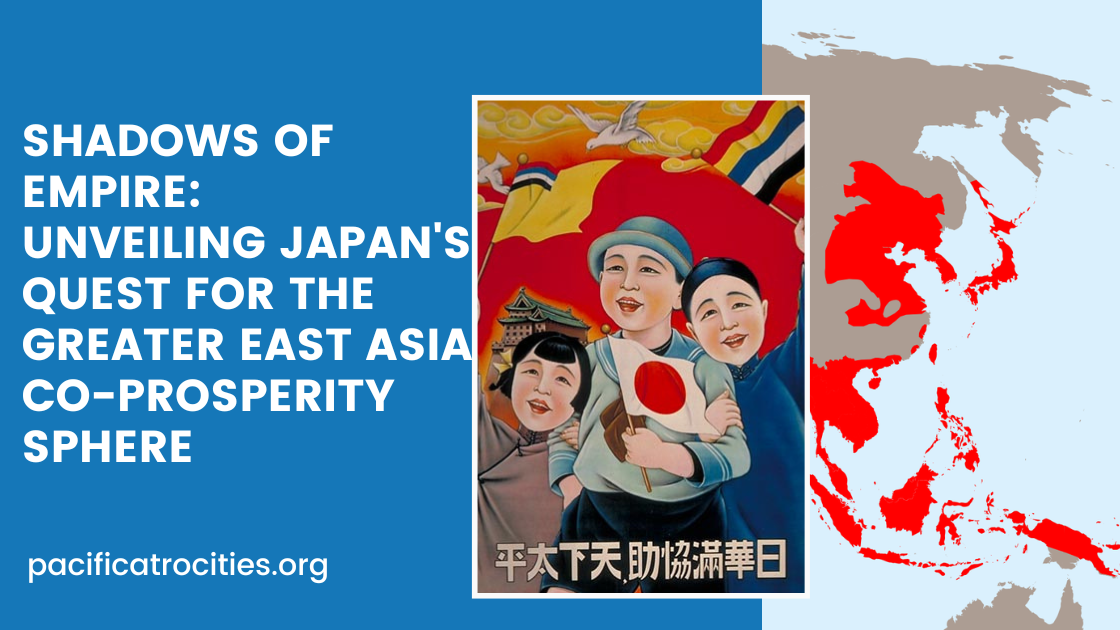
​On August 1st, 1940, Japanese Foreign Minister Matsuoka Yosuke officially delivered a decree that codified the unofficial policy and sentiments of the Japanese administration and military. This marked the establishment of the Greater East Asia Co-Prosperity Sphere (GEACPS), a strategic initiative aimed at creating a bloc of East Asian nations led by Japan and free from Western colonial powers.[1] With the use of an aggressive ideological framework, Asia must unite in the Japanese "spirit" and via Japanese stewardship.[2] Advocating for Pan-Asian unity under Japanese dominion, the GEACPS signified Japan's ambitions to expand its influence over territories not only under its control, such as Manchuria, Taiwan, Korea, and the Marshall Islands, but also those in Southeast Asia under Western colonial rule.
The proposed economic federation and sphere of security included new territories already occupied by European foreign powers in British Malay, the Dutch East Indies and French Indochina, and British Burma.[3] It's abundantly clear that the goal of the Japanese foreign policy, and later the security policy, was to galvanize the economic potential of these regions for Japanese industry. Japanese industry had come to rely on critical resources provided by Western powers via trade, chiefly iron, tin, rubber, and, most importantly, petroleum (Ibid. 228). Japan's aggressive expansion was partly fueled by the need for natural resources like iron, tin, rubber, and especially petroleum, the supply of which was severely impacted by the Roosevelt administration's embargoes.


The formal declaration of policy under the GEACPS was just a diplomatic formality for Japanese economic interests in Southeast Asia. This later manifested into a brutal military and naval campaign into South East Asia under the guise of Pan-Asian ideology and rhetoric. Using the Taiwan as an important launching pad for personnel, intelligence, and intercultural exchanges, Japanese military branches conducted lightning fast amphibious assaults and well-coordinated ground troops in what is known as the Southern Expansion Campaign.
  • 1931-1932: Japan invaded Manchuria, marking the beginning of aggressive territorial expansion in Asia.
  • July 1937: The Second Sino-Japanese War began, with Japan launching a full-scale invasion of China.
  • August 1940: The Greater East Asia Co-Prosperity Sphere was announced.
  • September 1940: Japan signed the Tripartite Pact with Germany and Italy, aligning itself with the Axis powers.
  • September 22, 1940: Japanese troops occupied northern French Indochina (present-day Vietnam, Laos, Cambodia) after the Vichy French government granted them access.
  • July 1941: Japan occupied southern French Indochina, further expanding its control in Southeast Asia.
  • December 7/8, 1941: Japan attacked Pearl Harbor, Hong Kong, Malaya, Singapore, and the Philippines, marking a significant escalation in the Pacific War.
  • December 1941 - January 1942: Japanese forces rapidly advanced into British Malaya and captured the key British fortress of Singapore in February 1942.
  • January 1942: Japan invaded Burma (Myanmar), aiming to cut off Allied supply lines to China and secure a buffer zone against possible British counter-attacks from India.
  • February-March 1942: Japan conquered the Dutch East Indies (now Indonesia), securing vital oil resources.
  • March 1942: Japanese forces occupied the Solomon Islands and the northern coast of New Guinea, extending their defensive perimeter in the Pacific.
  • May 1942: Japan suffered a strategic defeat at the Battle of Coral Sea, the first major naval engagement in which aircraft carriers played a decisive role.
  • June 1942: The turning point came with Japan's defeat at the Battle of Midway, where the U.S. Navy decisively defeated the Japanese fleet, significantly weakening Japan's naval power.
  • 1942-1944: Japan continued to expand in Southeast Asia and the Pacific but faced increasing resistance and counter-attacks by Allied forces.
  • 1944-1945: The Allied "island-hopping" campaign bypassed many Japanese strongholds in the Pacific, recapturing territory and moving closer to Japan.
  • August 1945: After the atomic bombings of Hiroshima and Nagasaki and the Soviet declaration of war on Japan, Japan surrendered, ending World War II in Asia and the Pacific.
Once perceived as Asian liberators or models of modernization, began replacing the functions set by their colonial predecessors in extractive industries. The "colonial yoke" remained in place. In some cases, nationalist movements and anti-colonial sentiments made certain Asian populations initially receptive to the Japanese occupation as an Asian contemporary that would respect their fellow Asian people's culture, religion, and society from Western colonialism.[4] In Vietnam and the Philippines, there was an underlying perception of the Japanese invasion as an opportunity for liberation, which likely contributed to national post-colonial consciousness.[5] Over time, the Japanese intentions became apparent and fixated on the extractive industries needed to fund their war efforts. The result was the massive destruction of property, land, and human life, which contributed to further colonial subjectivity. When Japanese troops aligned themselves with the Vichy French government in Indochina in 1941, much of the old colonial systems remained intact, and Vietnam later experienced one of the worst famines in its history as Japanese troops burned much-needed rice as fuel without much recourse. In Indochina, Malaysia, Thailand and Burma as many as 300,000 rōmusha laborers perished to construct the Burma Siam railroad, suffering from disease and fatigue. Poor Japanese women, or sometimes colonial Taiwanese and Korean women, were shipped to these parts of the Japanese realm to serve as comfort women to soldiers and laborers during these periods.[6]


After these subsequent atrocities, national movements began to question the official rhetoric of the Japanese administration in Southeast Asia, vastly contributing to their respective national movements and consciousness. For many of these nations, their service to the house of three masters came to an end in 1945 after the defeat of the Japanese and a vastly different world order came about.
1. International Journal of Humanities and Cultural Studies (IJHCS), Volume 6, Issue 1, Article "Japan’s Ideologies of Expansion: The Southern Expansion Campaign" https://www.arcjournals.org/pdfs/ijhcs/v6-i1/1.pdf
​2. Takeda, “Translation of The Greater East Asia Co-Prosperity Sphere by Koji Takeda”; Office of War Information, Bureau of Oversas Intelligence, “Japanese Treatment of Moslems in Java and Malaya, and Influence in Near East.”
3. Beasley, Japanese Imperialism 1894 - 1945, 227.
​4. My-Van, “Japan through Vietnamese Eyes (1905–1945),” 139.
5. My-Van, 129, 139; Abinales and Amoroso,
State and Society in the Philippines, 160.
6. Dower,
War without Mercy, chap. 3.

0 Comments


Leave a Reply.

Pacific Atrocities Education
1639 Polk Street #1070
San Francisco, CA 94109
​415-988-9889
Copyright © 2021 Pacific Atrocities Education.
​We are a registered 501 (c)(3) charity. All donations are tax deductible.​
Donate Now
  • Home
    • Host a Fundraiser for Pacific Atrocities Education
    • About >
      • FAQ's - Frequently Asked Questions
    • Support Us >
      • Projects you can support! >
        • Distributing Books
        • Presenting at 112th Annual Meeting of Pacific Coast Branch
        • Summer Research Relocation Fund
    • Contact
  • Stories
    • Videos >
      • Black Hearts (2021)
    • Blog
    • Podcast: Forgotten History
  • Internship
    • Summer 2026 Internship
    • Summer 2025 Internship
    • Spring 2025 Internship
    • Summer 2024 Internship
    • Summer 2023 Internship
    • Fall 2022 Internship
    • Summer 2022 Internship
    • Summer 2021 Internship
    • Fall 2020- Spring 2021 Internship
    • Summer 2020 Internship
    • Fall 2019 Internship
    • Summer 2019 Internship >
      • Public History Night
    • School Year 2018-2019 Internship
    • Summer 2018 Internship >
      • 2018 Summer Showcase + Fundraiser
    • Fall 2017 Internship
    • Summer 2017 Internship >
      • 2017 Summer Showcase & Fundraiser
  • Books
  • Archives
  • Resource Page
    • Supplementary Research Guides >
      • Unit 731 - Guide >
        • Background of Biochemical Warfare Development
        • Imperial Japan's Chemical Warfare Development Program
        • Map of Unit 731
        • Personnel of Unit 731
        • Duties of Unit 731
        • Human Experimentation
        • [GRAPHIC] Germ Warfare Attacks
        • Cover Ups After the War
        • [OLD] Cover Ups After the War
      • Philippines' Resistance - Guide >
        • Philippines World War II Timeline
        • The Japanese Invasion & Conquest of the Philippines
        • Bataan Death March
        • Formation of Underground Philippines Resistance
        • Supplies of the Guerrilla Fighters
        • The Hukbalahap
        • Hunter's ROTC
        • Marking's Guerrillas
        • United States Army Forces in the Philippines of Northern Luzon (USAFIP-NL)
        • The Aetas
        • Chinese and Filipino-Chinese Nationalist Guerrilla Units
        • The Female Faces of the Philippine Guerrillas
      • Rising Sun Flag - Guide >
        • History of the Rising Sun Flag
        • Atrocities Committed Under the Flag
        • Rising Sun Flag in Pop Culture
      • Pinay Guerrilleras - Guide >
        • Japanese Occupation of the Philippine Islands: Pinays Answering the Call to Arms
        • The Fierce Heneralas and Kumanders of the Hukbalahap Guerrillas
        • Amazons of the Pacific Theater
        • Filipina American Veterans: Recovering the Extraordinary Feats of the Ordinary Pinays
        • The Legacy of the Asian Women Soldier
      • Fall of Singapore - Guide >
        • Singapore World War II Timeline
        • History of World War II in the Pacific
        • History of Singapore
        • Japan's Conquest in Asia
        • Japan's Invasion of the Malay Peninsula
        • Sook Ching Massacre
        • Double Tenth Incident
        • Social Changes and Challenges in Singapore
        • Voices from Syonan
        • Return to British Rule
      • Three Years and Eight Months - Guide >
        • Hong Kong before WW2
        • Buildup to World War 2
        • The Battle of Hong Kong
        • Life during 3 Years and 8 Months
        • East River Column Guerrilla Fighters
        • Prisoners of War Camps
        • End of Japanese Occupation
        • War Crimes Trials
      • Siamese Sovereignty - Guide >
        • The Land of Smiles
        • The Thai-Japanese Relationship
        • Phibun’s Domestic and International Policies
        • The Free Thai Resistance Movement
        • Post WW2 Aftermath of Thailand
      • The Khabarovsk War Crimes Trial - Guide >
        • Defendants of Khabarovsk War Crime
        • The Japanese Empire and USSR in WW2
        • The Employment of the Bacteriological Weapon in the War
        • Planning of Japan invasion to USSR
      • Unit 731 Cover-up : The Operation Paperclip of the East - Guide >
        • Establishing Manchukuo
        • The Development of Unit 731
        • Plan Kantokuen and Bacteriological Warfare
        • The Downfall of the Japanese WW2 Era
        • Three Stages of Interrogations
        • Lasting Impacts
      • Marutas of Unit 731 - Guide >
        • How did Ishii Shiro start unit 731?
        • A Beta Testing Site
        • Establishing Pingfan
        • Experiences at the Human Experimentation Complex
        • Vivisection at the Unit 731
        • Anta Testing Grounds
        • Overall Advance from the Laboratory Creations
        • The End of the War
      • Prince Konoe Memoir - Guide >
        • Who is Prince Konoe?
        • Preparation to Tripartite Pact
        • Emperor Hirohito and Prince Konoe
        • The End of Prince Konoe
      • Competing Empires in Burma - Guide >
        • What was the China-Burma-India Theater?
        • When did the China-Burma-India Theater Happen?
        • Who Fought in the China-Burma-India Theater?
        • The Second Sino Japanese War
        • Japan in the South
        • Operation U-Go
      • Battle of Shanghai - Guide >
        • The Battle of Shanghai. Background
        • Shanghai Before War
        • The First Battle of Shanghai 1932
        • Battle of Shanghai 1937
        • Aftermath of Battle for Shanghai
      • Ishi Shiro - Guide >
        • History of Biological Weapons and The Young Ishii Shiro
        • Establishment in Manchuria
        • Pingfang District - Harbin
        • Failures and Corruption
        • Post War
      • Taiwan The Israel of the East - Guide >
        • Background of Formosa
        • Industrialization of Japan
        • China During WWII
        • Taiwan under Kuomintang
        • New Taiwanese National Identity
      • Seeking Justice for Biological Warfare Victims of Unit 731 - Guide >
        • Introduction of Wang Xuan
        • Colonel Memorandum
        • The Beginning of Biological Warfare
        • The Bacteriological Warfare on China
        • Victims in Zhejiang’s Testimonies
        • After the War
      • Rice and Revolution - Guide >
        • The French Colonial Period
        • Anti-Colonial Resistance
        • The Rise of the Communist Movement
        • Imperial Japan’s Entry into Indochina
        • The Portents of Famine
        • The Famine (1944-45)
        • Legacy of the 1944-45 Vietnam Famine
      • Clash of Empires - Guide >
        • Japan’s Imperialist Origins
        • Japan’s Competition against the West: Nanshin-ron and Hokushin-ron
        • Japanese Imperialism Through the Lens of French Indochina
        • The U.S.-Japan Relations and the Pearl Harbor Attack
      • Hunger for Power and Self-SufficiencyI - Guide >
        • The Influence of War Rations on Post-War Culinary Transformations
        • How World War II Complicated Food Scarcity and Invention
        • American Military Innovations
        • Government-Sponsored Food Inventions in Europe during World War II
        • Feeding the Army: The Adaptation of Japanese Military Cuisine and Its Impact on the Philippines
        • Mixed Dishes: Culinary Innovations Driven by Necessity and Food Scarcity
      • Denial A Quick Look of History of Comfort Women and Present Days’ Complication - Guide >
        • The Comfort Women System and the Fight for Recognition
        • The Role of Activism and International Pressure
        • The Controversy over Japanese History Textbooks
        • The Sonyŏsang Statue and the Symbolism of Public Memorials
        • Activism and Support from Japanese Citizens
        • The Future of Comfort Women Memorials and Education
      • Echoes of Empire: The Power of Japanese Propaganda - Guide >
        • Brief Overview of Imperial Japan
        • Defining Propaganda
        • Propaganda Encouraging Action​
        • The Rise of Nationalism
        • The Formation of Japanese State Propaganda
        • Youth and Education
      • Shadows of the Rising Sun: The Black Dragon Society and the Dawn of Pan-Asianism - Guide >
        • Origins of the Black Dragon Society
        • The Influence of Pan-Asianism
        • Relationship with Sun Yat-sen
        • The Role in Southeast Asia
        • The Spread of Ideology and Espionage
        • Disbandment and Legacy
      • Chongqing Bombing: The Forgotten Blitz of Asia and Its Lasting Impact - Guide >
        • Introduction and Historical Background
        • The Class Divide During the Bombings
        • Resilience and Unity of Chongqing
        • Key Incidents - Great Tunnel Massacre
        • The Aftermath of the Bombings
        • Legacy and Commemoration
      • Shanghai's International Zone: A Nexus of War, Intelligence, and Survival - Guide >
        • Historical Background
        • The International Zone
        • Battles in Shanghai
        • Civilian Intelligence Efforts
        • Wartime Brutality
        • Aftermath & Legacy
    • Lesson Plans >
      • Reparations
      • Ethics in Science
      • Writing the Narrative of a Pinay Fighter
      • Privilege Journal
      • Environmental Injustices
      • Female Guerrillas
      • Hunter's ROTC
      • Scientific Advancements
      • Seeking Justice: A Humanities Lesson Plan
      • The Hukbalahap
      • Trading Immunity
      • Bataan Death March
      • Biochemical Warfare Development
  • Membership
  • Community Movie Day
Contribute